How to Write a Resume for a College Student Internship

The key to writing a college student internship resume is to focus on your skills and experience, rather than just your education. Emphasize your accomplishments, affiliations, and extracurricular activities, which demonstrate your strong communication, leadership abilities, personal drive, and problem-solving abilities.
Include your physical address
You may think that listing an address on your resume is a bad idea, but it can help you land a job. The old fashioned way of getting hired was to send out mail. Today, employers rely on email and online portals. But this method of hiring is not without its drawbacks.
For example, it can be frustrating to get an appointment with a recruiter when your location is miles away from the office. Furthermore, long commutes can have a negative effect on productivity. That’s why it’s important to list an address on your resume if you plan to relocate to a new city.
Whether you are applying for a job in the U.S. or abroad, you should include an address on your resume. Your location shows that you are open to relocating, which can make the hiring process much easier for your future employer.
It’s also a good idea to include a phone number. While most communication these days takes place through email and phone, some companies still require a physical mailing address for onboarding purposes.
A full address can be very unwieldy to include on your resume. To save space, you can use a non-specific address to inform the hiring organization where you’re located. This could be a street name, zip code, or a general region.
If you’re worried about privacy, leave your address off your resume. However, if you have a close location, it’s wise to share that information.
Emphasize work experience more than education
A college student internship resume should be structured to highlight your strongest skills and personal traits. It should also be concise, but should include all of the pertinent information. If you are unsure how to make a resume for an internship, contact the Career Center at your school for help. They have resume writers who are experts in preparing resumes for college students.
One question often asked is which comes first, work experience or education? The answer depends on the type of position you are applying for. If you are applying for a technical job, you might want to put your professional experience first. Alternatively, you might want to emphasize your academic achievements.
Whether you are looking for a college student internship, a full-time job, or a career change, your educational background is a strong selling point. In fact, employers tend to overlook candidates who don’t have a degree. However, employers will still take your student status into account.
While most resume advice focuses on your personal experience, it is always a good idea to focus on your educational background. You should highlight academic honors, Latin honors, and any dean’s list. This is especially important if you are an international student. Your TOEFL scores can also be useful.
Although many resumes recommend that you place your education section at the top, it should actually be at the bottom. This is because it is likely to be more relevant to your job application than your work experience.
Include design elements
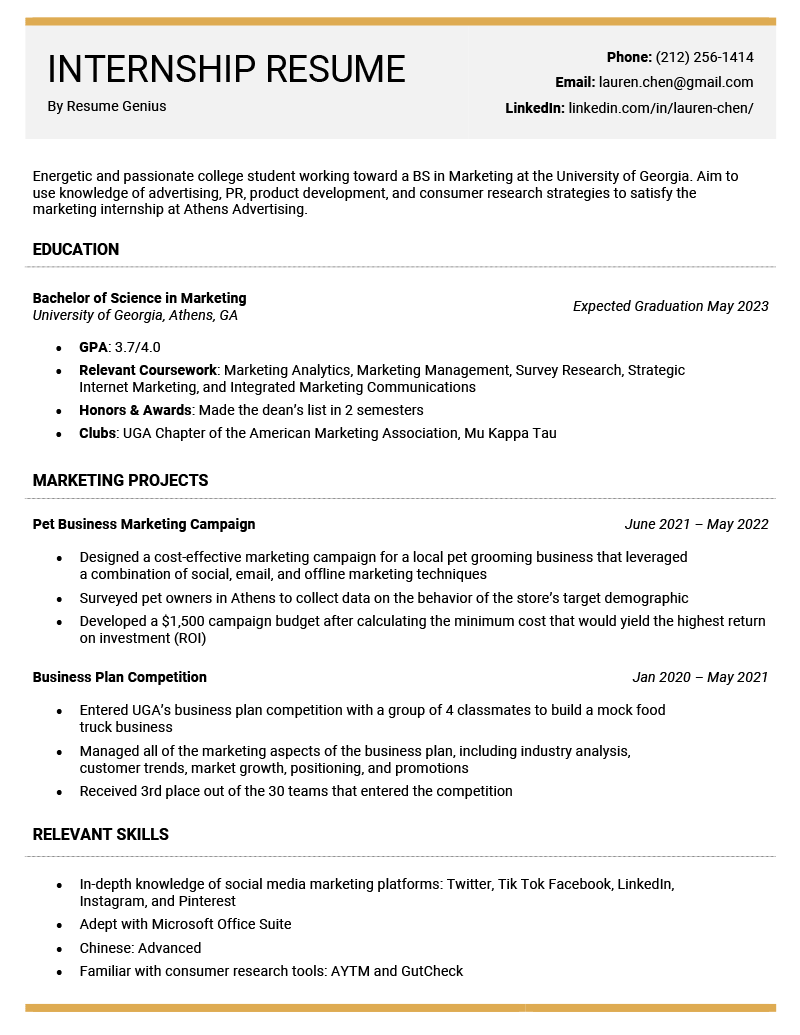
If you are going to write a resume for a college student internship, there are many design elements you can use to make your document a success. These include color, fonts, and design features such as shapes, shadows, and borders.
The best resumes include tasteful pops of color, well placed shadows, and other design elements that create a well-balanced effect. However, if you want to stick with a traditional layout, you may be better off sticking with black and white.
One of the most important design elements for a resume is to include an impressive header. This is an ideal place to highlight your most notable achievements. Also, make sure to include a live link to your social media profiles. Doing so will prompt interested parties to learn more about your resume.
Another important design element is using a custom typeface. A good font will add a touch of professionalism to your document. You can download ready-made templates from Adobe InDesign or you can try your hand at designing your own.
Using the right font can help you to impress your employer. Make sure to choose one that is easy to read and that suits the tone and style of your document. It’s also a good idea to have a different font for each section of your resume. Depending on the industry you work in, it might be wise to use a sans-serif or serif font for the body of your document.
Emphasize skills, accomplishments, affiliations, and extracurricular activities that demonstrate strong communication, leadership ability, personal drive, and problem solving
Adding extracurriculars to your resume can help you stand out from other candidates. In addition, they can teach you skills that are relevant to your career goals.
These activities can show your ability to work with others and lead them towards a common goal. While some traditional examples of extracurriculars include student government and debate, you can also list other experiences.
For example, volunteering at an animal shelter can be a great way to demonstrate your leadership abilities. Another example is a coding competition. Similarly, if you have worked on a project at school or university, it can demonstrate your technical and creative talents.
The achievement section of your resume should focus on extracurricular activities that are relevant to your career goals. It can be found anywhere on your resume, but should act as the final selling point.
One key to making your resume stand out is to create a cohesive portfolio of your accomplishments. This can be done with the addition of several categories, such as extracurriculars, education, and work experience. Each category should have a specific purpose.
If you are applying for a job in the medical field, for example, it is essential to demonstrate your interest in this field. Listing coursework related to this field is also critical.
Students can list their involvement in athletic teams, clubs, and societies in the education and experience sections of their resume. Some examples of extracurriculars that can be included in this section are national honor societies, student government, and debate.
Fill the limited space on your resume
When it comes to a resume, you want to make sure you’re including all the right elements. Your internship experience is a great way to showcase your skills and expertise. However, if you’re not quite sure where to start, here are some tips.
For starters, you should include an objective statement. This statement should be two to three sentences long, and it should take the employer’s needs into account. It should include the name of the company, the role you are applying for, and what you can offer.
Next, you should include an education section. The education section should include your GPA and the type of degree you are pursuing. You can even include the type of classes you’ve taken.
If you haven’t had any work experience, you can emphasize your academic achievements and your leadership potential. This is also a good opportunity to highlight extracurricular activities. These experiences demonstrate your dedication and motivation, and they help you develop skills.
You may need to spend some time editing your first resume to ensure that you’re highlighting the correct information. A letter of recommendation is a good place to begin. Also, don’t forget to check for contextual spelling mistakes.
The key achievements section is where you list your biggest accomplishments. Include a brief description of the work you’ve done, along with the name of your mentor. You can also include any projects you’ve done outside of school.
Emphasize your unique skill sets by adding design elements
A well-designed resume can help get you that job. Whether you’re applying for your first professional position or you’re a seasoned pro, you’ll want to make sure that you’re showing off the best of you. You can use design elements to showcase your strengths, such as a well-placed shadow or a clever use of color.
Using the right color combination can make a big difference. For example, you’ll want to choose a color that is both eye-catching and readable. Use a font that isn’t too dark or too light, but also not too small. This way, you’ll be able to highlight your most important accomplishments without taking away from your overall message.
The best part of this strategy is that it can be applied to a variety of different careers. For instance, if you’re in the health professions, you’ll want to highlight your clinical and volunteer experience. Likewise, if you’re in the communications or art fields, you’ll want to showcase your design and photography skills.
Of course, you’ll need to include your education, as well as your work and internship experience. If you’re not already using a professional resume template, you can create a simple version of your own. You’ll also want to use the best possible layout, including a grid structure, to maximize your space.
Besides the actual resume, you’ll need to write an effective cover letter. Whether you opt for a formal letter or an informal email, you’ll want to be sure that you’re highlighting your most impressive accomplishments.